

Making Publishing Accessible: Poinciana Paper Press and the Radical Act of Publishing Yourself
“The work I do through Poinciana Paper Press is to help people see how accessible it is to make books when we let go of conventional ideas of book formats, distribution, and how we ‘profit’” says its founder Sonia Farmer.
Farmer is a CCF grantee from the Bahamas. She first wrote down the idea for her project, Radical Acts of Publishing when she opened Poinciana Paper Press in 2022. She wanted to create a space where people could make and publish books on their own terms while building a movement for alternative, DIY publishing.
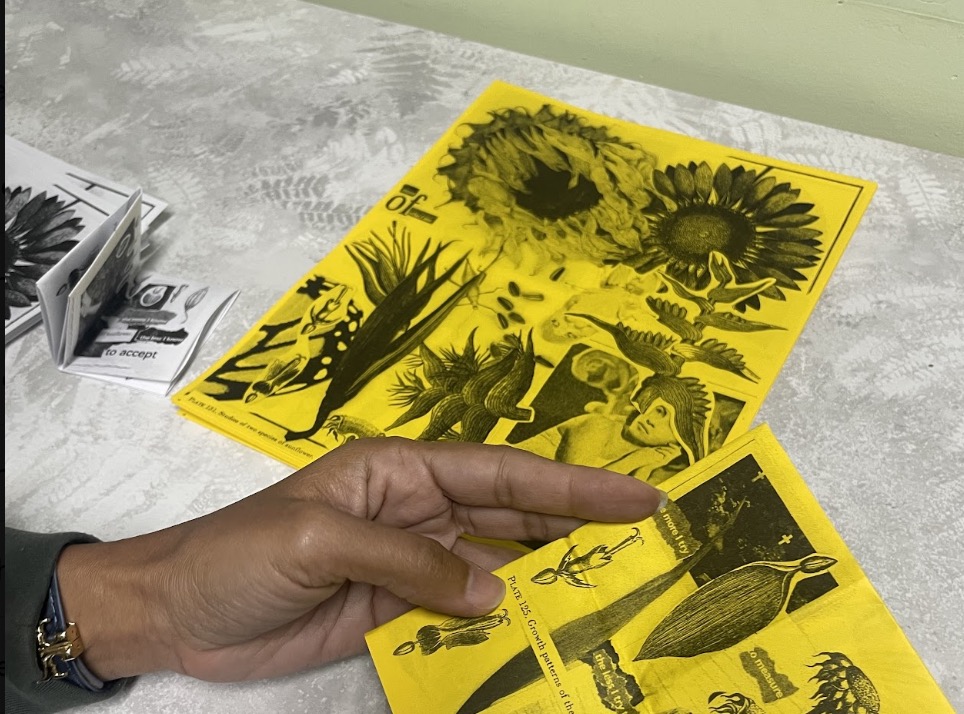
That vision became reality in 2025. With the CCF grant, Farmer hosted a six-week incubator that brought together more than twenty participants to imagine, design, print and bind their own publications using the studio’s equipment and a newly acquired Risograph printer.
Together, they produced nearly 50 publications, which were showcased and sold at a public exhibition at the Rabble! Bookshop in Nassau this June. The bookshop shares the premises, and now stocks publications produced through the incubator, giving participants an ongoing place to share their work.
To get into Farmer’s workshop, applicants had to submit only a short manifesto explaining why they wanted to take part; no resume, no previous publishing experience or fee. The response brought together familiar faces from Nassau’s literary community alongside people who had written privately for years without ever sharing their work. Farmer accepted every applicant, reshaping the programme to make room for them all.
The books reflect freedom. Several authors explored concerns about life in The Bahamas, including disappearing green spaces, land becoming increasingly inaccessible to Bahamians and the country’s dependence on the myth of “paradise.”
Others created deeply personal works about grief, family loss and healing, while some turned to satire through publications such as a “Gay Agenda” and a guide to being a bad daughter. Taken together, these books showed how independent publishing can make space for voices and experiences that are often overlooked.
Every participant began in the same place: a single sheet of paper folded into a book. Farmer deliberately kept the exercise low-stakes, encouraging experimentation before perfection. Some remained with the single-sheet format, while others expanded into pamphlets. What surprised many participants most was the amount of work involved in making a book, an understanding Farmer sees as an important part of the process.
“We are not making perfect art, we are learning how to be free,” says Farmer, quoting the artist and educator Tatana Kellner.
The Risograph printer helped turn Farmer’s vision into a lasting community resource. She describes it as a kind of printmaking photocopier, using layered printing techniques similar to screen printing. It now forms the centrepiece of Poinciana’s Community Digital Production Studio, where persons will continue using the space during future open studio sessions.
“Everyone brought themselves to the same book formats and used their own interests, thoughts, and talents to wildly different conclusions. In these days of homogenous AI-generated text and art, I see this kind of process as so much more important” says Farmer.
Farmer is now seeking support to make Radical Acts of Publishing an annual programme, with the long-term goal of welcoming writers and artists from across the Caribbean and its diaspora. Book-making and culture-making, she believes, should not rest on one person’s shoulders. There is room for everyone to share in that work.
Historically, publishers producing anthologies from the Caribbean often excluded The Bahamas, prompting many Bahamian writers to publish through local offset printers instead. Those independently produced books have since become an important part of the country’s literary canon.
Farmer points to Guanima Press and the Womanspeak Journal as examples of publishers that produced work for local audiences rather than the outside gaze, creating space for Bahamian voices on their own terms. She sees Poinciana Paper Press as part of that tradition and of a wider Caribbean movement that includes UN|FOLD in Trinidad, Toof Press, 6 ISLANDS zine and the Peekash Press chapbook series, all expanding opportunities for writers and artists to experiment, collaborate and publish independently.
The hope is to continue building the press as a place where more people can create, publish and share their own stories.
“Through creating a place where members can feel both held and free, we can provide a dedicated hub for liberation through making books.” closed Sonia.
Poinciana Paper Press — Nassau, The Bahamas